
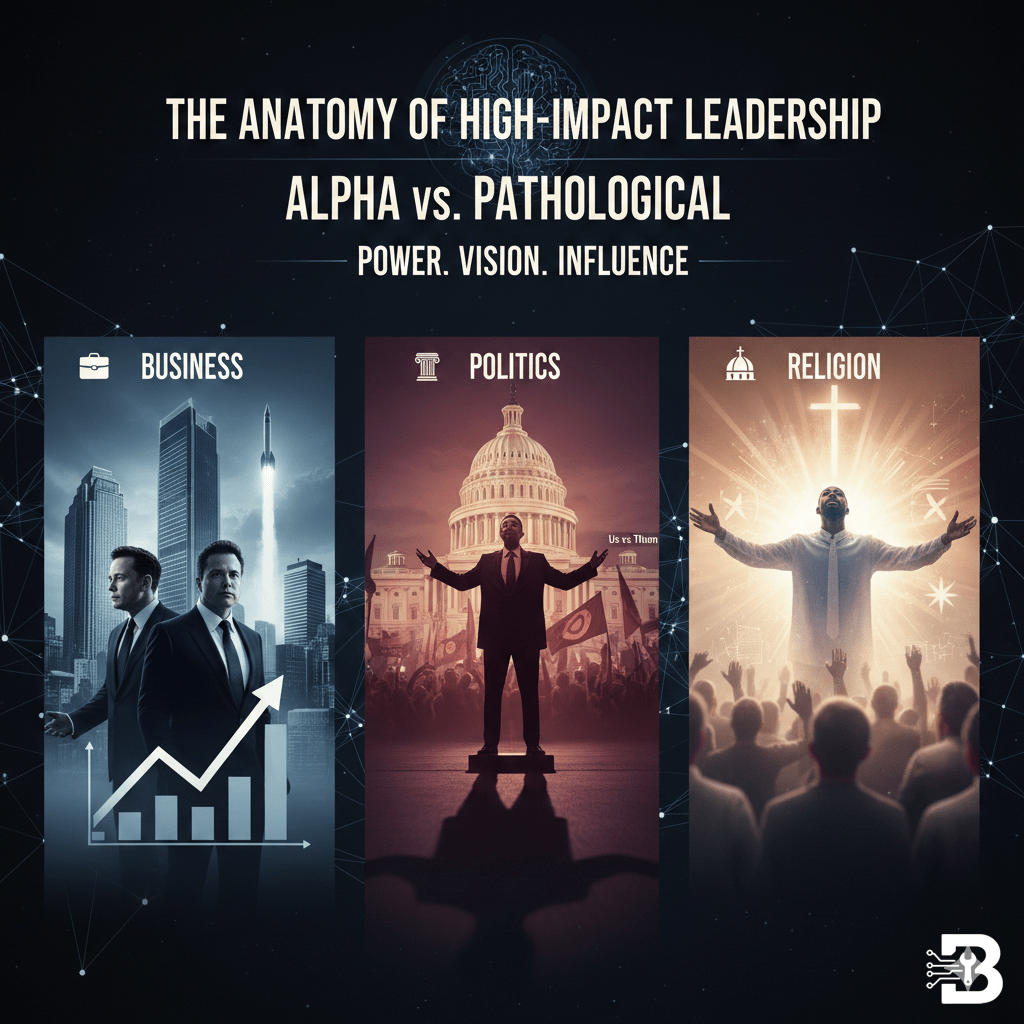
🏆 The Anatomy of High-Impact Leadership: Alpha vs. Pathological
To understand the world’s most powerful figures, we must move beyond the “billionaire” or “politician” labels and look at the internal architecture of their personalities.
https://youtu.be/3KB47GYA74o
🧠 I. The Psychological Architecture (The “Jagged” Profile)
Ultra-successful individuals rarely possess “balanced” personalities. Instead, they exhibit what psychologists call “Hyper-Traits.”
🌑 The Dark Triad: The Engine of Influence
Most high-level leaders score significantly higher than the general population on the three “Dark Triad” traits. While these are often seen as negative, they function as “competitive advantages” in high-stakes environments.
-
- Narcissism (The Visionary): Provides the grandiosity and self-belief required to pursue “impossible” goals. It creates a “Reality Distortion Field” where the leader genuinely believes they are destined for greatness.
-
- Machiavellianism (The Strategist): The tendency to view life as a game of chess. This allows politicians and CEOs to make cold, calculated decisions, manipulate public perception, and “play the long game” without being hampered by sentimentality.
-
- Sub-Clinical Psychopathy (The Executioner): Unlike “criminal” psychopathy, “corporate” psychopathy manifests as fearless dominance. It allows a leader to fire 10,000 people, withstand a national scandal, or risk their entire fortune without the paralyzing “stress response” felt by normal people.
🏛️ II. Domain-Specific Archetypes
The “flavor” of a leader’s dominance depends on the arena they occupy.
💼 1. The Business Titan (The “Obsessive”)
-
- Examples: Musk, Bezos, Gates, Walton.
-
- Primary Driver: Achievement and Efficiency.
-
- The “Pathology”: Often exhibits Asperger-like focus or OCD-adjacent perfectionism. They don’t want to “rule” people as much as they want to “build” a machine.
-
- Alpha Status: Earned through competence and technical dominance.
🗳️ 2. The Political Powerhouse (The “Inquisitor”)
-
- Examples: Presidents, Prime Ministers, Revolutionary leaders.
-
- Primary Driver: Power and Legacy.
-
- The “Pathology”: High Social Dominance Orientation (SDO). They view the world as inherently hierarchical and believe they belong at the top. They are masters of “affective polarization”—creating an enemy to unite a base.
-
- Alpha Status: Earned through rhetorical dominance and the ability to project strength.
⛪ 3. The Religious Prophet (The “Messiah”)
-
- Examples: Megachurch pastors, Cult leaders, Spiritual gurus.
-
- Primary Driver: Meaning and Affiliation.
-
- The “Pathology”: Divine Grandiosity. The dangerous crossover where the leader’s ego becomes indistinguishable from “God’s will.” This makes them immune to criticism, as any critic is seen as “evil” or “unbelieving.”
-
- Alpha Status: Earned through charisma and the promise of salvation or purpose.
👥 III. Why We Follow: The Symbiotic Relationship
The success of these figures depends entirely on the Follower’s Psychology. This is often a “Symbiotic Pathology.”
🛡️ The Search for the “Strongman”
In times of chaos or uncertainty, human biology triggers a “flight to safety.” We are evolutionarily wired to seek out a “Big Man” or “Protector” figure. We intentionally overlook their “pathological” traits (like arrogance or cruelty) because we perceive those traits as strength that will protect the “in-group.”
🎭 The Mirror Effect
Followers often live vicariously through the leader’s narcissism. When a billionaire buys a social media platform or a politician “crushes” an opponent, the followers feel a hit of dopamine, as if they achieved the victory themselves.
📊 IV. Alpha vs. Pathological: The Final Verdict
| Feature | The “Healthy” Alpha | The “Pathological” Elite |
| Empathy | Uses empathy to build teams. | Lacks empathy; uses “cognitive empathy” to manipulate. |
| Criticism | Listens and adjusts strategy. | Views criticism as a personal “declaration of war.” |
| Goal | To win the game or improve the world. | To prove they are superior and avoid being forgotten. |
| Morality | Operates within social norms. | Views themselves as “Above the Law” (Exceptionalism). |
🏁 Conclusion
Are they “Alpha” or “Pathological”? The answer is that they are Alphas because of their pathologies. The very traits that make them “disordered” in a domestic setting (like a lack of empathy, extreme risk-taking, and grandiosity) are the same traits that allow them to endure the brutal stress of global leadership. They are “Evolutionary Outliers”—individuals who sacrifice a “normal” life to occupy the extreme ends of the human bell curve.