
N2 TEA Laser Build – Part 2: The 10 kV Concept
[latexpage]
10,000 Volts: The Laser’s Secret Power
Okay, I’m ready to pull back the curtain! I’m building a Nitrogen ($\text{N}_2$) TEA (Transversely Excited Atmospheric) Laser. This is a high-performance physics experiment that relies on a single principle: speed. We use $10,000 \text{ V}$ to create an electrical pulse so fast it tricks the nitrogen gas (present in the open air, in this case) into emitting an invisible UV laser beam.
⚠️ Triple-Threat Safety Imperative: READ THIS FIRST
THIS PROJECT INVOLVES THREE DISTINCT LETHAL/HARMFUL HAZARDS. DO NOT ATTEMPT REPLICATION WITHOUT ADVANCED HIGH-VOLTAGE EXPERIENCE AND PROPER VENTILATION.
- 1. ⚡ Lethal High Voltage: The $10,000 \text{ V}$ circuit is lethal. NEVER touch the circuit when power is applied. All components must be contained within a grounded, non-conductive enclosure with safety interlocks before operation.
- 2. 💡 Harmful UV Radiation: The laser emits deep ultraviolet ($\text{UV}$) light (around $337 \text{ nm}$). This radiation is invisible, damaging to the retina, and can cause skin burns. NEVER look into the beam or at the spark without certified UV-blocking eye protection.
- 3. 💨 Toxic Ozone Production: The high-energy discharge generates ozone ($\text{O}_3$) gas (a toxic air pollutant). Operation must be limited to short bursts and always performed in a well-ventilated area or under forced exhaust.
Classroom Use: Replication in any educational setting requires direct, professional supervision and a fully interlocked safety enclosure system.
⚛️ The Physics: Why We Need Nanoseconds
The energy state of nitrogen that produces the UV laser only lasts for about 10 nanoseconds before it collapses. If the electrical discharge pulse takes any longer than that, the energy is wasted as a spark, not a laser.
We achieve this ultra-fast switching by using the Blumlein Transmission Line circuit , combining three elements:
- The Energy Tank: A massive parallel-plate capacitor bank.
- The Switch: A custom-designed Spark Gap.
- The Circuit: The Blumlein Transmission Line wiring.
🛠️ The Core Components (What I’m Using)
- The Power Supply: My $10,000 \text{ V}$ ($10 \text{ kV}$) $\text{DC}$ supply.
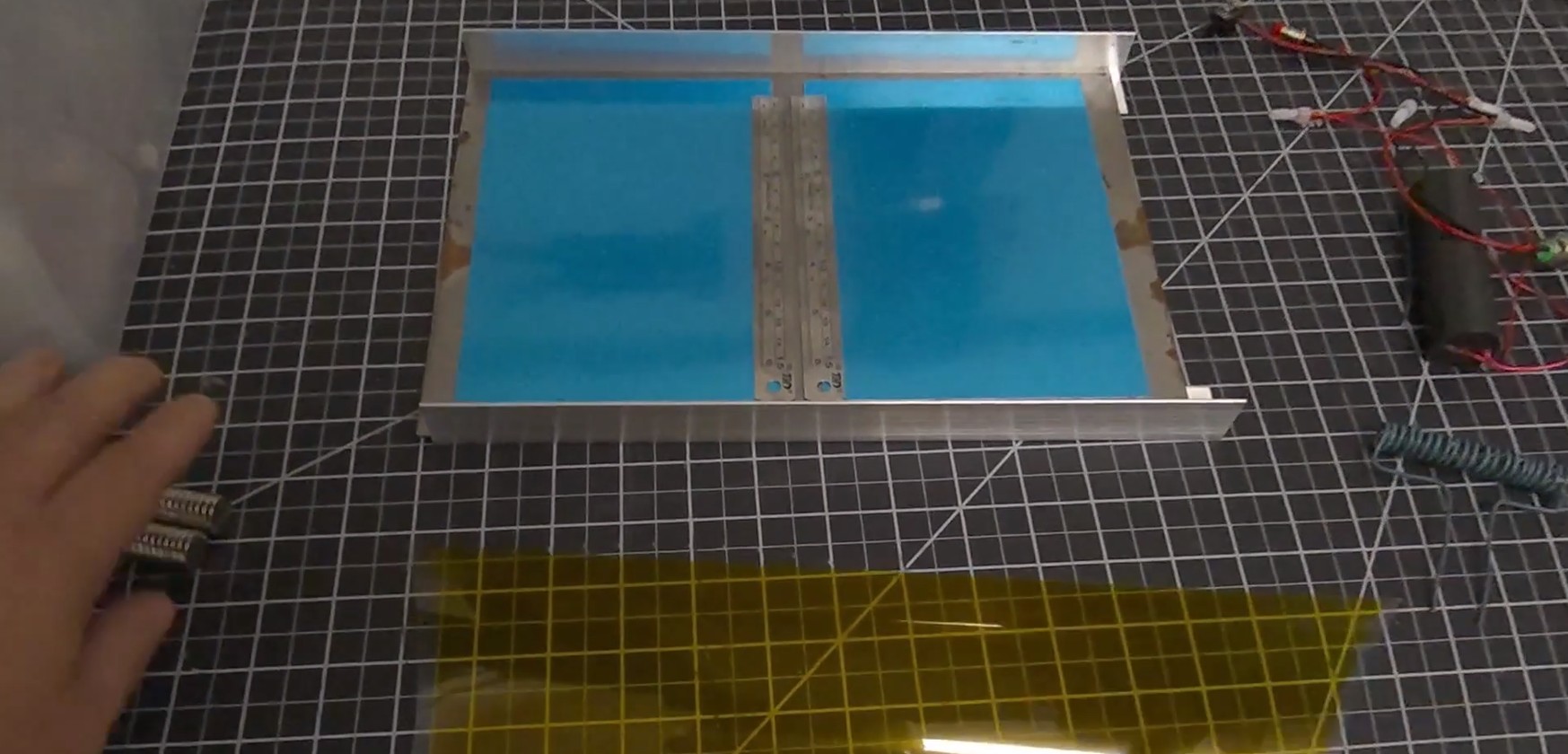
- The Energy Tank: The parallel plate assembly using the $200 \text{ mm} \times 300 \text{ mm}$ Iron Base Plate, two $5 \text{ inch} \times 7 \text{ inch}$ Aluminum Plates, and Kapton Film.
- The Laser Channel: The precise gap created by two $6 \text{ inch}$ Steel Rulers.
In the next post, I’ll dive deep into the math and design of the high-speed parts!